Compression. 3 Rods
SOM-3Rods-EN
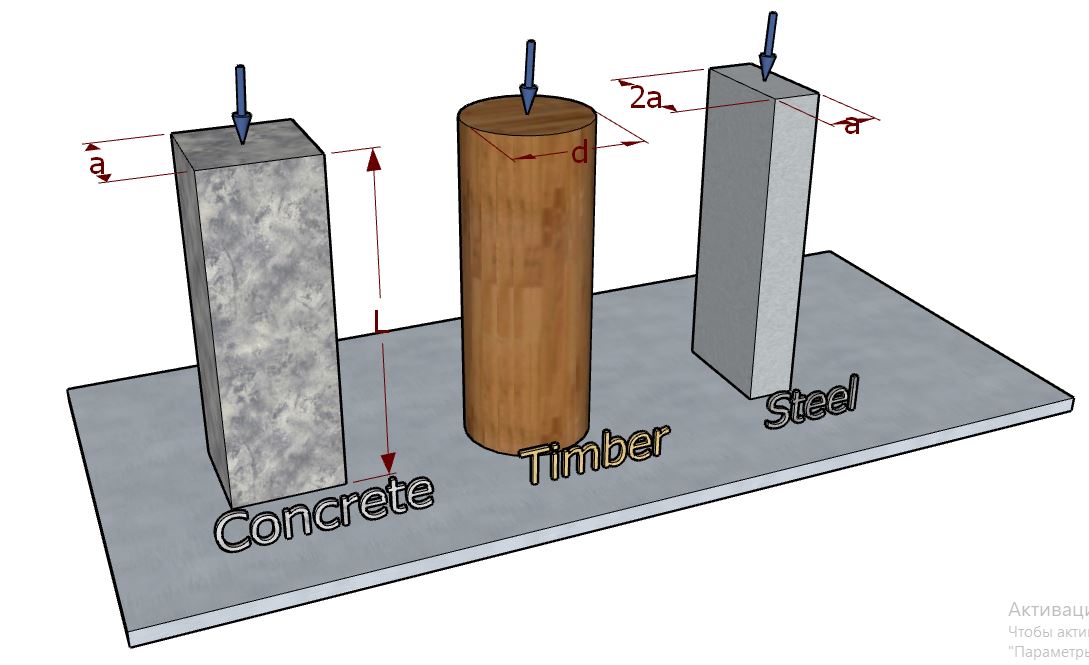
- a concrete bar with a square cross-section
- a wooden bar with a circular cross-section
- a steel bar with a rectangular cross-section.
The length of each bar is 1.4 m.
| Material | Allowable stress, MPa | Young's modulus, GPa (1 GPa = 1000 MPa) | Density, t/m3 | Material price |
| Concrete | 6 | 21 | 2.4 | 160 $/m³ |
| Wood | 11 | 10 | 0.8 | 800 $/m³ |
| Steel | 185 | 200 | 7.85 | 1500 $/t |
Concrete bar calculation
Required minimum cross-sectional area, cm2Wooden bar calculation
Required minimum cross-sectional area, cm2Steel bar calculation
Required minimum cross-sectional area, cm2This is a demonstration task — it isn't graded here. Add your own copy and it will appear under "My personal course" on the student page.
About this task
This task compares the behaviour of concrete, wooden, and steel bars subjected to the same axial compressive load. Students determine the required cross-sectional area for each material based on allowable stress, calculate the corresponding dimensions, evaluate elastic shortening using Young's modulus, and estimate both the mass and material cost of each bar. The exercise highlights the influence of material properties on structural performance and develops practical skills in axial compression analysis, material selection, and engineering design decisions. It is suitable for introductory strength of materials and mechanics of materials courses.