Learning topic
Arches
Analysis of statically determinate arches: three-hinged systems, reactions, horizontal thrust, internal forces, and the funicular axis.
An arch is a curved structural member in which vertical loading commonly produces both vertical support reactions and horizontal thrust. Because of its geometry, an arch can transmit a substantial part of the load through axial compression and may develop much smaller bending moments than a beam spanning the same distance.
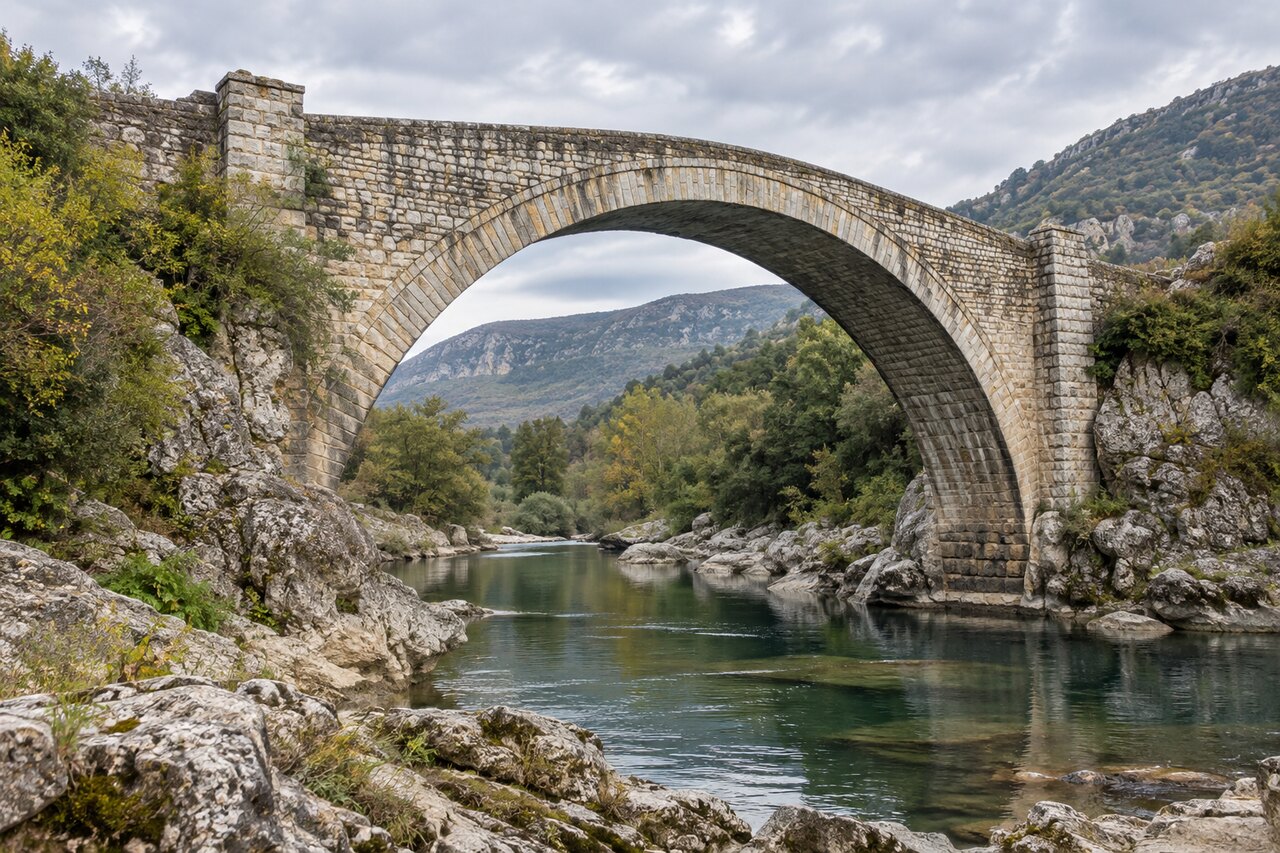
Statically determinate arches
The classical example is the three-hinged arch, with hinges at both supports and a third hinge at the crown or another point on the arch axis. The internal hinge cannot transmit bending moment, so the condition $M=0$ provides an additional equilibrium relation for determining the horizontal thrust.
Internal force effects
An arch section generally carries axial force $N$, shear force $V$ or $Q$, and bending moment $M$. Unlike a straight beam, the local section axes rotate along the curved member, so global force components must be resolved into tangential and normal directions.
Geometry and structural action
Bending moment depends on both loading and arch geometry. For a specified load pattern, a rational or funicular axis can be selected so that bending moments vanish or become small and the arch acts predominantly in axial compression.
About this topic
This section covers statically determinate arch systems, especially three-hinged arches: support reactions and horizontal thrust, internal forces, the influence of arch geometry, and the concept of a funicular or rational arch axis.